'Each man takes the limits of his own field of vision for the limits of the world'
-- Arthur Schopenhauer, Essays and Aphorisms

'Artists are tricky fellows sir, forever shaping the world according to some design of their own'
-- Jonathan Strange, Jonathan Strange & Mr Norrell

Monday, 16 May 2011

Iran and the Skype of Civilizations

A stone thrown at the right time is better than gold given at the wrong time
-- Iranian Proverb

The Iranian revolution is not exclusively that of Iran, because Islam does not belong to any particular people
-- Ayatollah Khomeini

On the surface, the state of Iran since the 1399AH revolution serves only as an instrument of the belief system. It is however the material interests of the regime which dominates its foreign policy choices, though often they can be cloaked and couched within cultural terms.

Since Iran has identified itself with a world ummah, this would suggest that the main foreign policy goal would be to promote Shi’a elements within neighbouring states and further afield. In fact, the geostrategic aims of state preservation and projection dominate. The collapse of the Soviet Union brought with it the independence of six muslim-dominated states bordering or close to Iran’s Eastern and Northern borders. In a demonstration of the fluid nature of culture, Iran has voiced Persian, Iranian and even Turkic concerns in order to appeal to identities, in support of state interests.

Chechen Muslims’ battle for independence from Moscow has not damaged excellent relations enjoyed between Russia and Iran, and when the situation became particularly acute, Iranian military personnel were dispatched to Moscow to assist in formulating strategy against the Chechens.

The Nagorno-Karabagh conflict that broke out in 1408AH between predominantly Christian Armenia and predominantly Shi’a Azerbaijan saw Iran support Armenia. Tehran adopted anti-Armenian rhetoric only during periods when escalation (1413AH) in the conflict directly threatened Iranian interests. To keep Azerbaijan focused elsewhere relieved pressure from its border.

In Tajikistan’s civil war (began 1407AH), Iran initially supported the Islamic Renaissance Party but switched support to a peace process and integration, in line with Moscow.

Many analysts have seen the initial interference by the Islamic Republic of Iran in other states as a signal of its intent to export Islamic revolution to the region. It supported agitation in Shi’ite towns in Saudi province of Hasa (late 1399AH and early 1400AH), also in Bahrain, and funded a terrorist campaign in Kuwait. In neighbouring Iraq, Iran sought to topple the Ba’th regime under the new ruler, Saddam Hussein and supported the Kurdish revolt in the North. So concerned was Iraq about the growing Iranian influence, that Saddam, backed by the United States, launched an attack on Iran (the war became known in Iran as the ‘imposed war’ and ‘holy defence’, in order to suggest a defence of Islam) starting a war that was to last 8 years, the longest conventional war of the century, which included strategic bombing, and cost 500 000 to 1 million Iranian lives and 300 000 Iraqi lives.

After Saddam, the Shi’a population in Southern Iraq seem less interested in Iran than with their own country. A universal ummah, voiced by leaders of the Iranian revolution has failed to become a popular regional narrative. The majority of the muslim world is Sunni. So what is Iran really doing geopolitically, behind the rhetoric and with what consequence for Arabia in its rebellions?

Iran uses Islam instrumentally to pursue state interests both at home and abroad. The ruling regime espouses a hard-line Islamic creed in order to subject its population to a tyranny created by controlling the monopoly on violence, as witnessed by the suppression of the uprising in 1430AH. It enjoys best relations with Christian populated Armenia and secular Turkmenistan. Enemies are determined by material interests and strategy rather than an apocalyptical vision of religious battle but the rhetoric, the justification, is religious. The United States serves as the Great Satan, being blamed for Armenia expelling hundreds of thousands of Azerbaijani refugees, Russia attacking Azerbaijan and attacking Chechnya.

Recently, the regime in Bahrain has attempted to paint the protests there as inspired and supported by Iran. The protestors are mainly Shi’a and the regime is Sunni, as is the Gulf Bloc that condemned Iranian interference yesterday. The bloc also condemned an alleged Iranian spy network in Kuwait. But wikileaks disclosures have noted an absence of Iranian intervention in the country amid continued unrest between the Shi’a population and the Sunni regime. Bahrain is wary of the threat according to a US diplomat, ‘While keeping close to their American protectors, Bahrain's rulers seek to avoid provoking Iran unnecessarily, and keep channels of communication with Iranian leaders open.’ American diplomats meanwhile see no evidence of Iranian weapons or funding in the country for over two decades.

Culture

It is plausible to view Iran as as ‘Iranic’ civilization, at once part of, but distinct from, the broader Islamic civilization. Many elements of the population, which is a cultural composite, reject notions of Persian identity, or indeed a state-centred Iranian identity. Iran’s bipolar disorder, as at once a self-proclaimed vessel for a trans-state interest (the ummah) but also the state itself, leaves it open to multiple cases of contradicting policy and rhetoric. Policy choices can be made that contradict official rhetoric without damaging the credibility of the regime, suggesting that cultural norms can be remade under pressure without serious consequence. In fact, the name Islamic Republic of Iran suggests conflicting identities – as part of a world Islamic faith, as being a republic respondent to the needs and desires of the populace, and of being the state of Iran, a geographically shackled entity with commensurate state interests. The Iran-Contra affair of 1406AH, in which Iran was supplied arms from America, via Israel, is a case where material interests dominated the anti-Western rhetoric.

President Ahmadinejad, for all the immensely negative portrayals of him in the West is a shrewd politician. Even as a hard-liner, he was propelled to victory on the back of an election that painted him as a man of the people. He has ostensibly sought to engage the youth, pushing for allowing women to enter football stadiums and to lower the voting age from 18 to 15. He is also astute in the field of foreign policy, arguing against human rights abuses in other countries. His controversial speech at Columbia University in 1428AH, preceded by Lee Bollinger’s emotive outburst, was an unqualified propaganda triumph.

The discrepancy is that hard-line rhetoric which expresses the most anti-American sentiment of any ruling regime covers a remarkably young and pro-American population. America contains a significant Iranian diaspora and a remarkable grass-roots activist community (for example, lissnup.com). As such, there exists an internet-enabled dynamic between the population in Iran and in the United States that flies in the face of the axis of evil versus the great satan. The positive future for America must, ironically, be seen in Iran above all other countries in the region. Close ties are already being forged between Iranian academics, journalists, students and activists and there American counterparts. Intrigue might not change Iran, demographics and time will do so, inevitably. 

Given the military might of the Iranian regime, international condemnation over its actions, particularly domestic repression is muted at the highest political levels. The young demographic, itself a product of the revolution, when the rulers closed family planning clinics and praised large families, will ultimately enact the change against the regime. 66% of the population are under 30, 40% are under 18. The social prospects for this generation will be poor, as the economy will not be able to provide enough socially mobile jobs. There are places for only 400 000 of the 1.5 million university applicants. Lack of material prosperity and lack of recognition will be the two great drivers of change in the coming years. The internet demonstrates the world that Iran can have, but does not yet have physical access to.

The regime understands the problem. It has purged the universities of its opponents (for instance the case of Hashem Aghajari) and created policies that favour students with pro-regime leanings. The primary student group is the Office for the Consolidation of Unity, a regime-backed entity that promoted Islamic ideology evolved rapidly to become autonomous. A spin-off group, the Union of Islamic Associations was formed with similar radical activist composition. Since media outlets and journalists have been subjected to harsh penalties, censure and the latter with imprisonment, the Internet is the ideal medium through which the youth and anti-regime voices can regroup and articulate themselves. Some sources suggest that there are 80 000 female bloggers in Iran. Up to 150 000 to 200 000 people leave Iran each year through legal or illegal means, contributing to the immense ‘brain drain’ in the country.

Whilst the Qu’ran is a document which appeals to the poor, Iran is a country where 10% of the population controls 76% of the resources. 12% of the population live in absolute poverty. Iran is a wealthy country, with $70 billion in oil revenues in 2008 so its poverty is a direct result of political negligence. Radical egalitarian theories espoused by Mahmud Talequani and Mohammad Baqer Sadr have grown in popularity, as they expound a redistribution of wealth. Job creation would need to stand at 800 000 yearly in order to quell discontent. The demographics do not add up and a point will be reached where the prospect of continued poverty and unemployment will be outweighed by the potential gains of a mass uprising.


Tuesday, 10 May 2011

Caveman

'And now, I said, let me show in a figure how far our nature is enlightened or unenlightened: Behold! human beings living in a underground cave'
--Socrates in Plato's The Republic, Book VII

My final thoughts on the cave/luxury compound. Daniel Byman writes in Foreign Affairs this month ('Terrorism After the Revolutions', published before the bin Laden killing) that, 'indeed, looking out from bin Laden's cave, the Arab world looks less promising [for Jihadists] than it did only a few months ago.'

A Pakistani woman photographed her daughter at the gate of the compound where Osama bin Laden was killed in Abbottabad, Pakistan. Copyright: Aqeel Ahmed/AP, reproduced by NYT here.
This made me realise that whilst both the West and the Jihadists propagate the idea of bin Laden in the cave, they do so for opposed reasons. The West puts bin Laden in a cave because it visualises him as a cave-dweller and his jihad as a throw back to an era before history, before civilization. He's hiding from the forces of enlightenment and order in the dwelling of neanderthals. The cave serves to illustrate the lack of progress that can be made by the jihadists, their inability to produce social contracts, institutions of government, technology, infrastructure. Indeed, much of the work at CTC, West Point has focused on the absence of any jihadist blueprint for government (see inter alia, Lahoud, N. (2010) The Jihadis' path to self-destruction). Having moved away from the Muslim Brotherhood's ideals of politicised Islam, which made concessions in order to produce a palattable idea of government, the jihadists rejected all forms of the political, preferring only the relationship between the individual and God - thus the West demonstrates this apparent rejection of civilisation by production of an atavistic image and accompanying narrative. 

The jihadist propagation of bin Laden in a cave is meant to enhance the bin Laden brand - the myth of the man as a symbol. In this way he becomes more than a figurehead, he seeks the amplitude of the idea of his self into something broader and less tangible. He is the austere leader who has rejected Western luxuries in pursuit of jihad. He has travelled to the peripheries of the Islamic world to fight to expand the dar-al-islam, at the boundaries of the dar-al-harb. The cave is where the warrior in the mountain lives. Compare this with Rashid ad-Din Sinan, known to history as 'the old man of the mountain', the leader of the infamous hashashain sect (of the heretical Nizari Shi'a) in Syria in the 12th century and considered in some contemporary writings as semi-divine. Bin Laden, is (or, was) attempting to portray himself as the living embodiment of the untainted 'Salafist jihadist' (the term is Kepel's) ideal. 

Strange then, that he ends up in the million dollar compound...

Tuesday, 3 May 2011

The Cave/Luxury Compound Dichotomy

I wonder if it's of any consequence, but when I think of bin Laden, it's in a cave or in a mountainous region. 

Bin Laden in Af-Pak border. Beside him the presence of an AK-47/AKM indicates the violent nature of Jihad and his credentials as a soldier of God.


Bin Laden's appeal stemmed in part from his rejection of the luxurious Saudi lifestyle which his family, as a construction empire embedded with the House of Saud, had come to know. Many who had met him during the later part of the Afghan civil war spoke of his humility and his austere living. How many times have we been told that he is in a cave complex? First in Spin Boldak during the end of 2001 and later in the FATA that sit between Pakistan and Afghanistan. The Singaporean diplomat who asked, 'how can one man in a cave outcommunicate the world's greatest communication society?' was not alone in assuming that bin Laden had gone to ground. 

The Qu'ran is a leftist document, it appeals to the disenfrancised. It distinguishes between justice and injustice. It empowers the poor and resents the rich. Bin Laden was a living embodiment of this literature. He had rejected luxury for his faith. This was part of the myth. So what does it mean that when killed, he was living in a $1million dollar gated villa in a beautiful town in Pakistan? Does it mean that his fighting had merited his luxurious retirement or do his followers, adherents, admirers and sympathisers expect the great sacrifice of the man to endure to his end? The smouldering gated compound is an odd final image for the man who became thought of as the old man of the mountain. He had the comfort of and support of many members of his family who were with him in the complex.

The general history of his habitation is delineated by Jason Burke today in a Guardian piece:
"In the late 1990s, for propaganda purposes, Bin Laden invited select journalists to meet him in caves near Tora Bora in eastern Afghanistan. However he lived in a much more comfortable compound a short drive away, near the former Soviet collective farm of Hadda owned by a local warlord. By 1999 he had moved to a complex of houses near Kandahar. When he was killed, he was living in a relatively comfortable detached house in Abbottabad, Pakistan. In between, there is no evidence that he spent any time living in caves. The rest of al-Qaida's senior militants appear to have lived in the semi-fortified houses that are common in the tribal zones."

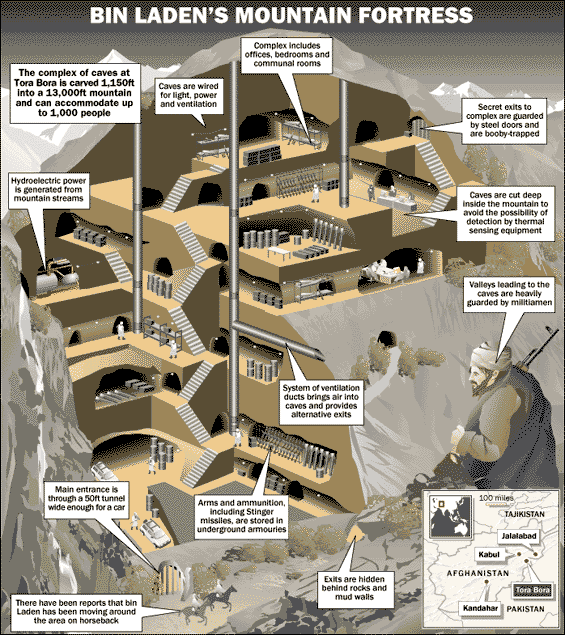
Both the Western and al-Qaeda narratives propagated the 'idea of the cave'. November 29, 2001, the London Times apparently carried an amazing (in hindsight) image (I haven't verified this graphic but see also SKY) of what the US-led forces would encounter in Spin Boldak, in keeping with this James Bond evil villain intent on world domination theme that had developed in the aftermath of 9.11 in the media:
The New York Times and no less a polarizing figure than Donald Rumsfeld both asserted that these cave complexes existed, the latter suggesting there were many of them. Jason Burke (2003, I.B.Taurus/London, p.73) argued as much, drawing on evidence from interviewees (showing the difficulty of differentiating fact and fiction in these accounts).

The Cave Caveat

The residence of a public figure has been important in some recent Islamic narratives. When Ahmadinejad was running for President of Iran, it was widely held that his decision to let media film his austere, basic living quarters generated a spike in approval. Ahmadinejad also achieved notoriety by driving around in a three-decade old Peugeot 504. Jihadists often commentate on the disconnect between the wealthy American politicians and the fighters that prosecute their wars. 

Finally, it's not a powerful, resonant final act that bin Laden constructed. Rather he was a passive unwilling participant in it. No opposite forces were harmed. There was no great stand-off or siege but instead he went quietly into the night. No enduring images or myth to be embraced by jihadists across the globe. He now becomes consigned to his writings and pronouncements and thought of in that luxury villa, sixty miles from Islamabad.

Monday, 2 May 2011

Osama Bin Laden's Death - Ten Things That Happen Now

1. Obama is re-elected in a landslide
Strange how bin Laden's last impact was to influence a Western election. Just as jihadist acolytes had driven the encumbent Iraq-invasion supporting government in Spain from office when they bombed the Madrid trains, and just as bin Laden's video may have left Kerry stranded in the polls and precipitated Bush returning to office, in being killed during Obama's first term, his death will return the president to a second term. Clinton said it's, 'about the economy, stupid', but when you've killed the West's most wanted man after a ten-year hunt, well, that helps your popularity, too.
The chap in the spectacles [bottom right] isn't convinced by it all. "They promised me strippers at this party," he's thinking.

2. Al-Qaeda axis shifts
Many jihadii experts can name at least three centres of AQ activity - al-Qaeda Central (operating out of the autonomous regions of Pakistan); AQ in the Islamic Maghreb (operating principally from Algeria but with transnational reach in the Sahel); AQ in the Arabian Peninsula (operating ostensibly from Yemen, protected by the powerful Awlaki tribe in the region).
Bin Laden has been a marginal figure at best in recent years. The absence of an al-Qaeda spectacular in a decade has led to dwindling funds from sympathetic Saudi figures and other wealthy Gulf admirers. Since his position as the 'world's most wanted man' (I thought that was Prince Harry now, judging by the outpouring of love at the Royal Wedding), he has been dropped from the command structure, operating merely as a symbolic figurehead of spiritual and motivational significance. Even his audio releases merit less air time on Jazeera.

3. Drone use accelerated
Drones have been operating with impunity in the Pakistan borders and will almost certainly been used in this operation in a reconnaisance capacity. To limit their game-changing effects, the al-Qaeda axis will have to shift to new areas, in fact, the drone element may produce an extremely fluid geographical command structure, to the detriment of the group. Leon Panetta has been a big fan of drones. Arguably, drone use is what has allowed bin Laden to be killed now.

4. Mainstream America labours under false assumptions
The cheering crowds of hundreds in front of the White House chanting, "USA, USA" show the palpable relief on the face of a nation. Undoubtedly, the national psyche, so used to "getting things done" and overcoming obstacles by sheer tenacity and willpower, was emasculated by its inability to find "one man in a cave" and who had escaped in Spin Boldak on the Af-Pak border after British special forces may have been asked to stand aside so that US special forces, who then waited for substantial air support, could capture the prize during Operation Anaconda. But bin Laden is really unrelated to the changes that have affected al-Qaeda and the greater jihadist movement.

Dangerously, the world now comes to write Osama bin Laden's obituary. Throughout his later life he was able to harness history to his cause. Through 9.11, an act that he may have funded, the United States prosecuted two exhausting wars, firstly in Afghanistan, that is still ongoing, and in Iraq, which have redirected the emphasis in its military from a peerless symmetric fighting force to the role of counter-insurgency specialism.

Bin Laden's ideology was found wanting, in that jihadism failed to articulate any state-centric blueprint for rule. Jihadists have never toppled government because their means and aims are one and the same - jihadist terrorism that seeks no concessions. The making of a global ummah is as unrealistic and unattainable a goal now as it was a decade ago. It seeks to homogenize under a single banner a religion that is fractured. It ignores politics or working nation-states and devises an as yet unarticulated relationship between the individual and God. For all his peerless spiritual and moral leadership to the jihadis, the group and its affiliates must seek a new direction...


5. Jihadist in-fighting momentarily ceases
They will be debating what comes next at Langley and Vauxhall Cross. Either jihadist leaders seek to move themselves centre-stage in the wake of the figurehead's demise, or they coagulate, support and unify. Initially, and with the drone spectre still hanging over them, it seems unlikely that any figure will want to assume leadership. The groups will produce a new wave of invective against the West and stress the aims of their movements, which, as noted, has become an untenable, "jihad for jihad's sake".
 
6. Ayman al-Zawahiri assumes de facto leadership
He may not want the position, but Zawahiri is now the figurehead of al-Qaeda. The real leaders will make themselves known by their words, actions and ability to garner funding in the difficult times ahead. For leading sympathisers that fund the group, al-Qaeda Central is becoming something of an irrelevence. Other groups offer more creativity and tenacity in the north-west frontier province. Jaish-e-Mohammed (JeM) and Laskar-e-Taiba (LeT) with training facilities in Kunar province, though only regionally-focused, are large and well-funded groups with high operational capacity in the region. 

7. Al-Awlaki becomes main focus
Operating from Yemen, al-Awlaki now certainly represents the new threat from al-Qaeda. It is not the once in a decade spectaculars that he will propagate, instead he will continue to flatten the jihad structure and as a consequence inspire many more operations but of a less serious magnitude. Whilst he will still focus on trying to achieve hits on soft Western targets, most terrorism will now assume a regional-focus whilst the CIA has the momentum. Gulf patrons of al-Qaeda will be more favourable to coalescing around al-Awlaki than the former Egyptian-based al-Zawahiri - the latter will struggle to hold onto to these important financial bases which may result in him being increasingly isolated. Zawahiri understands the failings of AQ in recent years - his commentary on the 'Arab Spring' as recently as last month has still failed to hijack the uprisings. Jihadism is failing as an idea, many will now look to al-Awlaki to offer some reorientation.

8. Pakistan and U.S. relations worsen
When Pakistan was formed from the Indian-Muslim population in the postcolonial-melting pot after the Second World War, it sought to ally itself with the US to balance power from its regional rival India. Ever since, the US and Pakistan have enjoyed some sort of relationship. Indeed, when the US sought to support radical mujahideen elements in their war against the Soviet puppet in Afghanistan, the CIA channelled its funds through the ISI. Relations must now be at a low ebb. Bin Laden was living in a walled villa in a town sixty miles from the Pakistani capital, Islamabad. Early reports indicate that he had been living there for at least eight months.
It must be assumed that at no point were the Pakistani authorities allowed to know of CIA intelligence nor party to the special forces hit. This suggests that ISI/CIA cooperation will now move to a much lower level. Drone strikes will escalate in the autonomous regions and may even move to Pakistan proper. The CIA will argue that high level operatives are obviously being hidden in Pakistan with the knowledge of elements within the ISI, so the operations should likewise move to within the country. The CIA gets a huge boost from this operational success. Zawahiri and al-Awlaki next in line for the CIA AQ-hunters. Mi6 role in the intelligence aspect of the operation will be interesting, considering their largest base abroad is in Islamabad, 60 miles from where the world's most wanted man was living. Surely this demonstrates the continued difficulty of operating in culturally distinct regions.

9. US nationalism met with increased anti-Westernism
Well Gaddafi, if al-Qaeda were in charge of the uprising against you then the US have done you a great favour. Images of US celebrations beamed worldwide and nationalist chanting do little to offset anti-Westernism, though Obama's muted, defiant statement in the White House was very media savvy affording the al-Qaeda propagandists absolutely nothing to work with. Similarly, OBL's burial at sea allows no physical recovery of the body for propaganda purposes.

10. Pippa Middleton photographs are moved off the front pages of the tabloids.
But probably only briefly.